

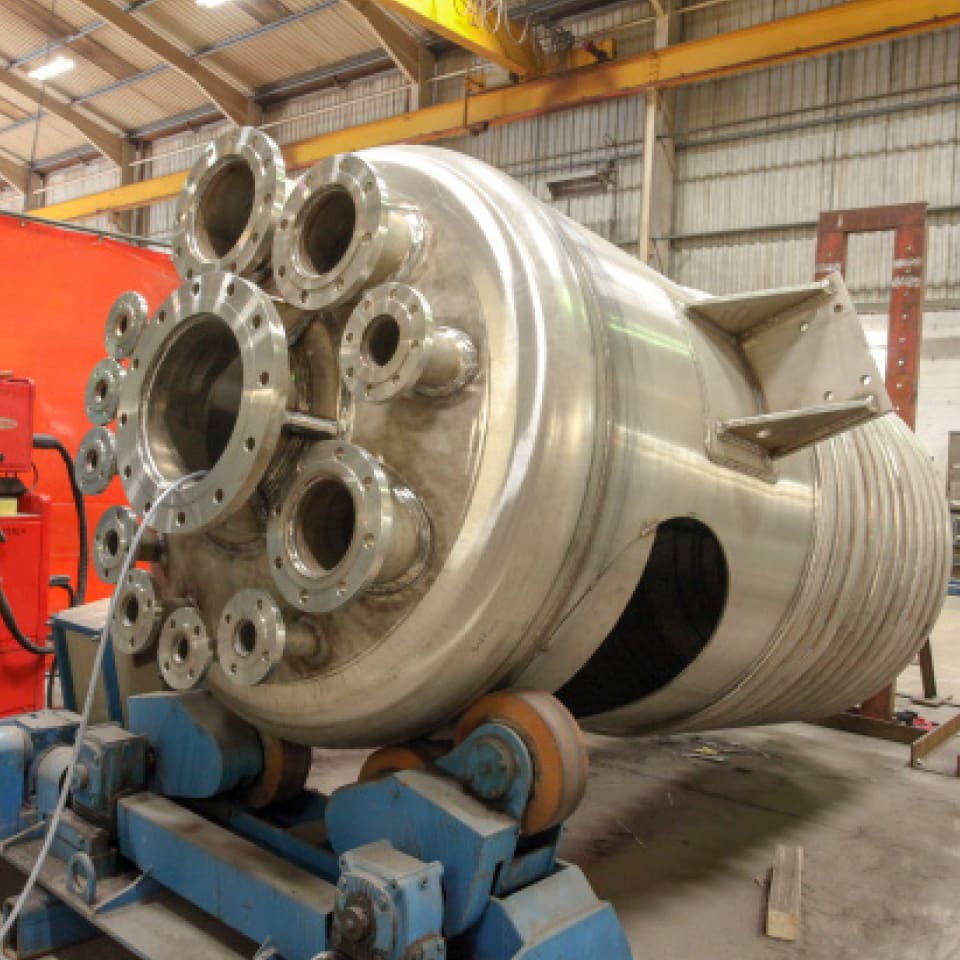
Why Use a Coded Welder and Vessel Design Engineer When Ordering a Pressure Vessel in the UK
When it comes to ordering a pressure vessel — whether for chemical processing, pharmaceutical manufacturing, food and beverage production, or energy generation, the stakes couldn’t be higher. A pressure vessel contains fluids or gasses under pressure, and failure can lead to catastrophic consequences: explosions, toxic releases, fires, loss of life, and massive financial and reputational damage.
In the UK, compliance with stringent safety regulations isn’t optional, it’s mandatory. And two of the most critical roles in ensuring that compliance are the coded welder and the qualified design engineer. Skipping or cutting corners on either is not just risky, it’s legally perilous.
Here’s why you must insist on both when ordering your next pressure vessel.
1. The Role of the Coded Welder: Precision Under Pressure
A coded welder is not just someone who can weld metal. They are certified to specific welding standards, most notably BS EN ISO 9606, and have demonstrated their ability to produce welds that meet the exacting requirements of pressure equipment under the Pressure Equipment Regulations 2016 (PER) and the Pressure Equipment Directive (PED) 2014/68/EU.
Why does this matter?
Safety Integrity: Welds are the weakest points in a pressure vessel. A single flawed weld can lead to catastrophic rupture. Coded welders undergo rigorous testing under controlled conditions to prove they can consistently produce defect-free welds on specific materials (e.g., carbon steel, stainless steel, duplex) and joint configurations.
Legal Compliance: Under PER, all pressure vessels in the UK must be constructed by personnel certified to recognised welding standards. Using non-coded welders renders the entire vessel non-compliant, meaning it cannot be legally placed on the market or put into service.
Inspection & Certification: Independent Notified Bodies (like TÜV, LRQA, or SGS) inspect pressure vessels during manufacture. If they find welds performed by non-coded personnel, the vessel will be rejected. You’ll face costly rework, delays, or even complete scrapping.
Insurance & Liability: In the event of an incident, insurers will investigate certification records. If your vessel was built by non-coded welders, your insurance may be voided, leaving you exposed to unlimited liability.
Real-World Example: In 2023, a UK-based food processor faced a £1.2M fine and a 6-month shutdown after a steam vessel ruptured due to substandard welds. The welder had no valid certification. The company had assumed “any qualified welder” was sufficient. They learned the hard way: in pressure equipment, “qualified” doesn’t mean “experienced”, it means “certified to code.”
2. The Role of the Design Engineer: Engineering for Safety, Not Just Function
A pressure vessel isn’t a tank; it’s a highly engineered pressure containment system. The design engineer is responsible for ensuring the vessel meets all technical, mechanical, and regulatory demands.
A qualified design engineer for pressure equipment must:
• Be proficient in ASME VIII Div. 1/2, PD 5500, or EN 13445; the recognised design codes in the UK.
• Perform rigorous stress analysis, corrosion allowance calculations, thermal expansion modelling, and fatigue life assessments.
• Account for operating conditions: temperature, pressure cycles, fluid compatibility, and external loads.
• Issue a formal Design Calculation Report and Materials Certification traceable to EN 10204 3.1/3.2.
• Ensure the design is reviewed and stamped by a Responsible Technical Engineer (RTE), as required under PED.
Without this, you’re essentially asking a fabricator to build a container based on a sketch, not a safety-critical engineering document.
Non-compliant designs can fail under normal operating conditions, even if the welds are perfect.
– Undersized nozzles, inadequate shell thickness, or unconsidered thermal stresses can lead to premature failure.
– UK Health and Safety Executive (HSE) enforcement officers routinely audit design documentation. Missing or non-compliant engineering data is a red flag and can trigger immediate prohibition notices.
Case Study: A UK pharmaceutical company ordered a vessel designed by an in-house mechanical engineer with no formal pressure equipment certification. The vessel operated for 18 months before a fatigue crack developed at a nozzle junction. The root cause? The design ignored cyclic thermal stresses. The vessel was taken out of service, production halted for 12 weeks, and the company was fined £480,000 for failing to use a competent design engineer.
Why Both Are Non-Negotiable Together
Think of it this way:
The design engineer creates the blueprint for safety.
The coded welder executes that blueprint with precision.
One without the other is like having a perfectly designed airplane but built with untested rivets.
The UK’s regulatory framework (PER + PED) is built on the principle of “conformity assessment”, and this requires documented evidence of both correct design and correct fabrication. This is why reputable pressure vessel manufacturers:
– Employ in-house certified welders on their approved welding procedure specifications (WPS).
– Employ chartered or registered design engineers with PED experience.
– Provide full CE marking and Declaration of Conformity backed by Notified Body certification (if required).
Any supplier who cannot provide:
– Copies of welder certifications (ISO 9606),
– Design calculations stamped by a qualified engineer,
– Material test reports (MTRs),
– And a full audit trail from design to delivery,
…should not be considered.
What You Should Demand When Ordering
Before signing any contract for a pressure vessel in the UK:
1. Ask for proof of each welder’s current certification (ISO 9606) for the specific materials and processes to be used.
2. Require the design engineer’s credentials, ideally, chartered status (CEng) or equivalent, with a track record in pressure equipment.
3. Verify the manufacturer’s quality management system is certified to ISO 9001 and ISO 3834 (welding quality requirements).
4. Confirm whether a Notified Body is involved — especially if the vessel is Category II or higher under PED.
5. Insist on access to the design calculation report and welding procedure qualification records (WPQR).
Don’t settle for “we’ve done this before.” In pressure equipment, “before” doesn’t count if it wasn’t done to code.
Final Thought: Safety Is Not an Expense — It’s Your Best Investment
Pressure vessels are expensive. But a failed vessel? The cost is incalculable.
By insisting on a coded welder and a qualified design engineer, you’re not just complying with the law, you’re protecting your employees, your customers, your facility, and your business reputation.
In the UK, where health and safety standards are among the most rigorous in the world, cutting corners on pressure equipment is a gamble you simply cannot afford.
Choose a supplier who treats safety as their first priority — not an afterthought.
Because when it comes to pressure vessels, there’s no room for error.
Luckily for you; Richard Alan Engineering offers all of the above, a dedicated team of coded welders and a team of design engineers who specialise in their specific category including pressure vessels, silos, storage tanks, structural steelwork and pipework.
Get in touch
Want to know more about what we offer? Got a specific project you’d like to discuss? Then we’d really like to hear from you! Call us on: +44 (0)1924 467040 or contact us online using the button on the right